

You pull into your driveway after a long day. It’s October in Glendale, and the sun has already set, leaving a cool evening in its wake. You press the remote, ready to close the garage door and head inside, but it stops a few feet from the ground and reverses. You try again. Same result. Now the opener lights are blinking, and your secure, convenient garage has suddenly become a source of frustration. As a lead garage door technician with over a decade of experience, I’ve seen this exact scenario play out countless times. A garage door that won’t close is one of the most common issues we encounter, and it often seems to happen at the most inconvenient times - like after dark.
The good news is that in many cases, the cause is simple and can be identified with a few quick checks. This guide will walk you through the common signs, causes, and steps you can take to diagnose why your garage door won’t cooperate.
Common Signs and Symptoms
When a garage door refuses to close, it usually provides clues about what’s wrong. Our technicians are trained to interpret these signals to quickly pinpoint the problem. Here’s what you should look for:
- The Door Reverses After Starting to Close: This is the most frequent symptom. The door travels a short distance toward the floor and then immediately goes back up. This behavior is a clear indication that the opener’s safety mechanism has been triggered. If you have a situation where your garage door closes then reopens Glendale, this is almost always the cause.
- The Opener Lights are Blinking: Modern garage door openers use flashing lights as a diagnostic code. For instance, many popular brands will flash the main lights 10 times when there is a safety sensor issue. If your opener lights blinking won’t close the door, it’s the machine’s way of telling you exactly where to start looking: the photo-eye sensors near the bottom of the door tracks.
- The Door Only Closes When You Hold Down the Wall Button: Try pressing and holding the button on your wall-mounted control panel. If the door closes completely as long as you keep the button depressed, this is a definitive sign of a safety sensor problem. This action manually overrides the sensor system, confirming that the sensors are the reason the door won't close on its own.
- You Hear a Click, But Nothing Happens: Sometimes, you’ll press the remote and hear a click from the motor unit, but the door doesn’t move at all. The lights may or may not flash. This can also point to a sensor issue, but it could also indicate a problem with the opener's internal components.
What Causes This Problem
Understanding the root cause is key to a reliable fix. While it may seem like a major failure, the reason your garage door won’t close is often related to its most important safety feature: the photo-eye sensors.
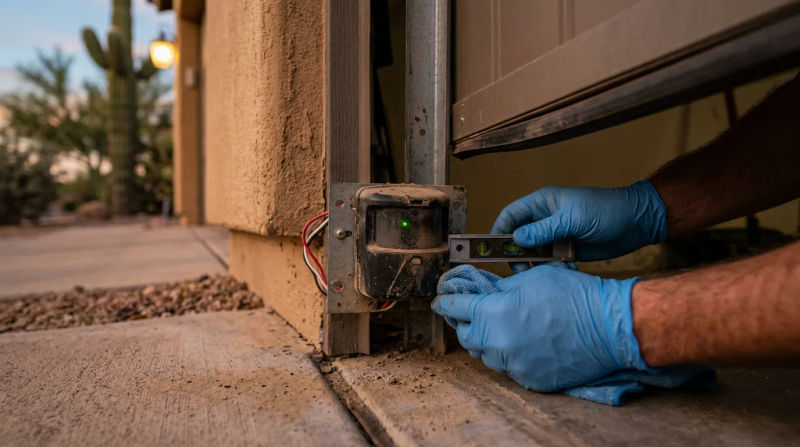
- Safety Sensor Misalignment: This is, by far, the number one reason for a door that reverses. At the bottom of your garage door tracks are two small sensors, each about six inches off the floor. One (the sender) projects an invisible infrared beam to the other (the receiver). If anything breaks this beam while the door is closing, the door reverses to prevent injury or damage. However, these sensors can get bumped or knocked out of alignment easily. In Glendale, the cooling evening temperatures can cause concrete garage floors to shift ever so slightly, which is sometimes enough to misalign the sensors. A key step in Glendale garage door sensor alignment is to check the small LED lights on each sensor. Typically, both should be glowing steadily. If one is flickering or off, they are not aligned.
- Dirty or Obstructed Sensor Lenses: Dust, dirt, cobwebs, and even morning dew can accumulate on the sensor lenses, blocking the infrared beam just as a physical object would. This is especially common in our dusty Arizona climate. Wiping the lenses with a clean, soft cloth is often a quick and effective fix.
- Glare and Sunlight: The shorter days in October mean the sun is at a lower angle. Direct sunlight hitting one of the sensors can sometimes